
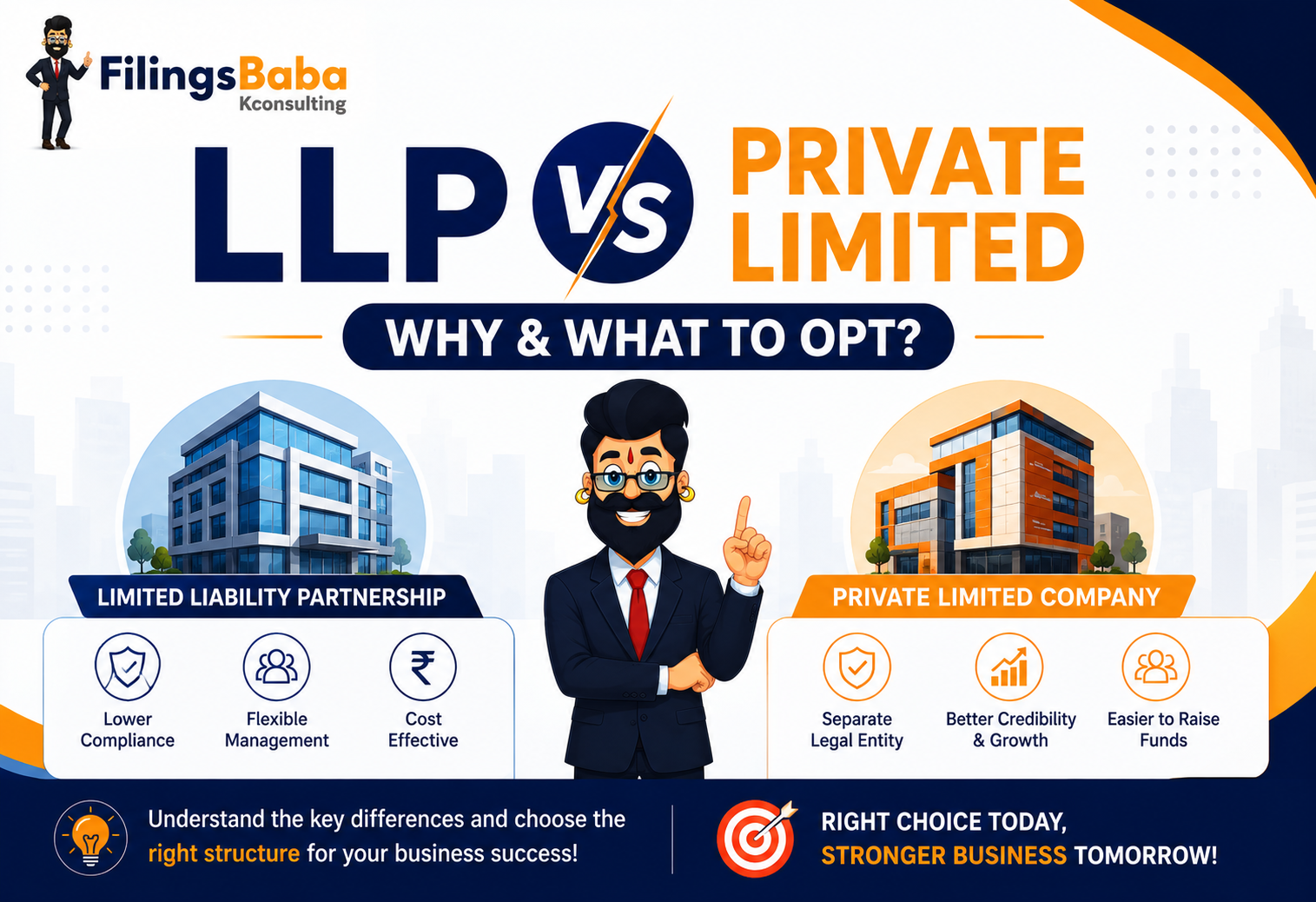
LLP or Private Limited Company: Which One Should You Choose?
If
you're starting a business in India, this is probably the first big question
you're stuck on. LLP or Private Limited Company. Your CA says one thing, your
friend says another, and every blog seems to copy the same comparison table
that doesn't help you decide.
Let
me try a different approach. I'll skip the textbook definitions and tell you
what these structures actually feel like to run — what you'll pay, what you'll
comply with, and which works for which kind of business.
The
Real Question
The
right answer depends on one thing: what kind of business are you running,
and where do you want it in three years?
Two
friends starting a small consultancy and splitting profits — they should
probably go for an LLP.
Two
co-founders building a tech product who plan to raise from investors — they
need a Private Limited Company.
Same
country, same law book, completely different best answer.
Cost
of Setup: LLP Wins on Day One
A
Private Limited Company costs more to register. You pay government fees on
authorised capital, state stamp duty, and higher professional fees because the
documentation is heavier — MOA, AOA, director KYC, share allotment records.
An
LLP is leaner. There's no authorised share capital concept, the LLP Agreement
replaces the elaborate MOA/AOA, and government fees are lower. For most basic
registrations, an LLP can be 30–40% cheaper.
But
this is just day one. The real cost difference shows up over the years that
follow — and there, the answer flips.
Compliance:
LLP Genuinely Wins Here
Annual
compliance for a Private Limited Company is heavy. AOC-4 and MGT-7 every year,
board meetings with proper minutes, an Annual General Meeting, mandatory audit
(regardless of turnover), DIR-3 KYC for every director, statutory registers —
the list is long.
Even
a dormant Pvt Ltd costs roughly ₹15,000–₹25,000 a year just to stay alive in the eyes of the
law.
LLP
compliance is far lighter. You file Form 8 and Form 11. Audit is mandatory only
if turnover crosses ₹40 lakh or contribution exceeds ₹25 lakh. No board meetings, no AGM, no exhaustive
registers.
For
a small consultancy or services firm that doesn't need investor capital, this
is a huge ongoing saving — both in money and in the mental load of keeping up
with deadlines.
Taxation:
Closer Than People Think
Here's
a myth to bust: people say "LLP saves tax." That's only half-true.
A
Private Limited Company is taxed at 22% (under the new regime for new domestic
companies that don't claim incentives) or 25% otherwise. An LLP is taxed at
30%. So Pvt Ltd has the lower headline rate.
But
when a Pvt Ltd's profits are paid out as dividends, there's a second layer of
tax in the shareholder's hands. With an LLP, partners can withdraw profits
without that second layer, and remuneration to working partners is deductible.
The
takeaway: for a profitable owner-run business where money goes into the
founders' pockets, LLP is often more tax-efficient overall. For a business that
retains and reinvests profits, Pvt Ltd works fine.
Raising
Money: Pvt Ltd Is Non-Negotiable
If
you have any plan to raise external funding — angels, VCs, even a serious bank
loan — stop considering LLP.
Investors
don't invest in LLPs. Term sheets are written for Pvt Ltd structures. Equity,
preference shares, ESOPs, convertible notes — none of these work cleanly in an
LLP. The whole startup funding ecosystem is built around the share capital of a
company.
Even
if you find an investor willing to put money into an LLP, you'll spend months
structuring it awkwardly and then convert to Pvt Ltd anyway. You've paid twice
and lost momentum.
If
raising is on your roadmap — even possibly — start with a Pvt Ltd. The extra ₹5,000–₹10,000
at incorporation is the cheapest insurance you'll ever buy.
Credibility
With Big Clients
This
is uncomfortable but real. Indian B2B markets — corporates, enterprise clients,
government tenders — still perceive a Private Limited Company as more
"serious" than an LLP. It's not always rational, but the perception
matters.
If
your business depends on closing big enterprise deals, Pvt Ltd carries weight.
If your clients are individual consumers or small businesses, this is largely
irrelevant.
ESOPs:
Always Pvt Ltd
If
you ever want to give equity to employees as part of compensation — or to a
co-founder joining later — LLP makes this clumsy. ESOPs are designed around
share capital. Founders who plan to incentivise a team with upside need a Pvt
Ltd.
The
Honest Decision Framework
Strip
everything else away and ask yourself four questions:
- Will
you raise external funding in the next three years? Yes → Pvt Ltd.
- Will
you offer ESOPs to attract talent? Yes → Pvt Ltd.
- Do
you sell mainly to large enterprises or government? Yes → Pvt Ltd.
- Are
you a small, profitable, owner-run services business with 1–4 partners and
no plans to scale aggressively?
Yes → LLP.
Most
professional services firms — CA practices, law firms, consultancies, design
studios, agencies — are LLPs for good reason. Most product startups, tech
ventures, and growth-focused businesses are Pvt Ltds for good reason.
What
If You Get It Wrong?
It's
not the end of the world. You can convert. LLP to Pvt Ltd and Pvt Ltd to LLP
are both legally allowed. It involves filings, approvals, and tax implications,
but it's possible.
Don't
paralyse yourself trying to make the perfect choice. Pick what fits your next
18–24 months. If your business evolves, the law gives you a path to switch.
One-Line
Summary
Small,
profitable, owner-run services business → LLP.
Anything
involving investors, ESOPs, or fast scaling → Private Limited Company.
Everything
else is detail.
Need
Help Deciding?
Picking
the right structure is one of those decisions that feels small at incorporation
and looms large three years later. If your situation has nuances — multiple
co-founders, foreign partners, sector-specific licensing — it's worth a quick
conversation with someone who's seen both work and both fail.
At
FilingsBaba, that conversation is free. We've registered both structures across
industries and we'll tell you honestly which suits your business — even if it
means recommending the cheaper, simpler option.
Reach
us at contact@filingsbaba.com
or +91-9958592769 when you're ready to talk it through.
This
post is for general guidance. Specific tax and legal advice should always come
from a qualified professional aware of your particular situation.
